Bonus Guide 3
Aircon Troubleshooting Handbook
Kompletong reference para sa pag-diagnose ng common aircon problems — kung anong safe checks ang pwede mong gawin, at kung kailan kailangan ng qualified technician.
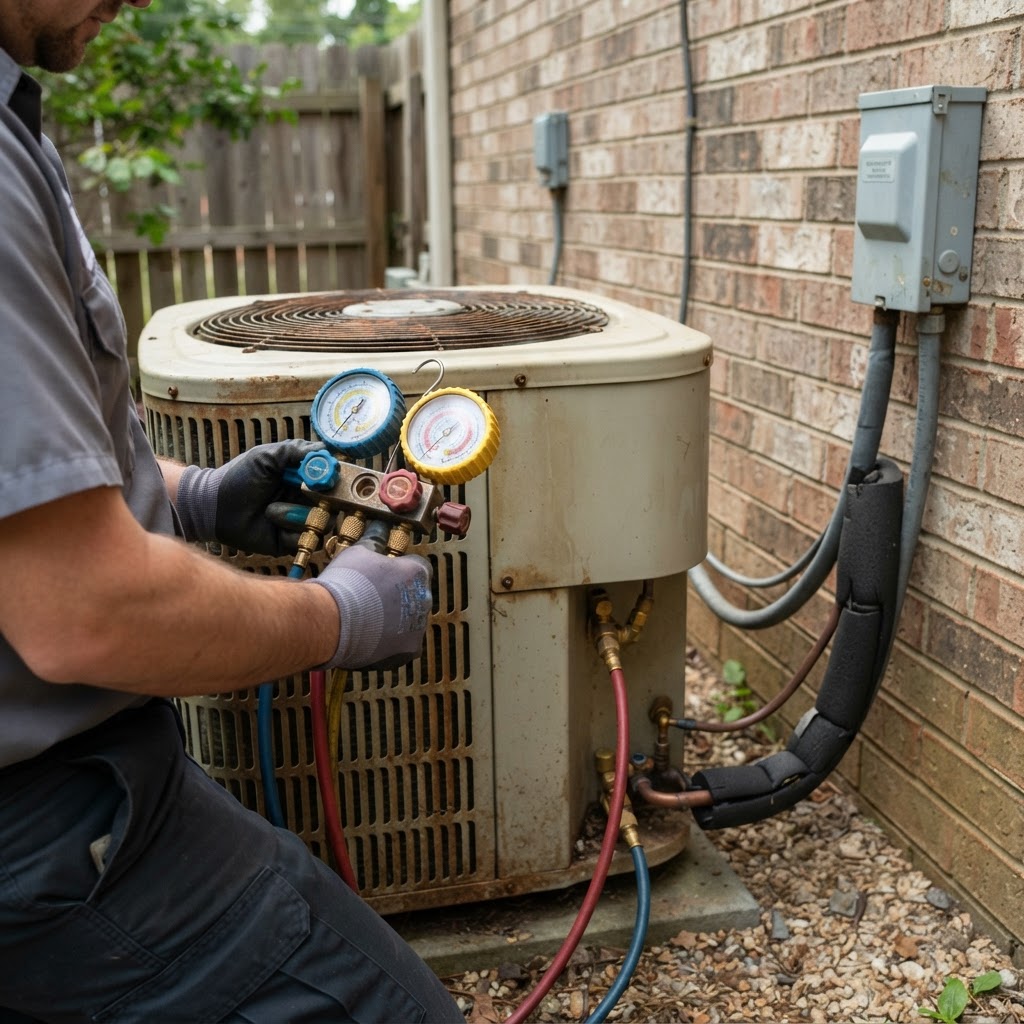
Manifold gauge set — sinusukat ang suction at discharge pressure para ma-diagnose ang refrigerant charge at system health.
⚠️ Safety Warning
📐 Basic Diagnostic Flow
Unit problem?
  │
  ├─ Not turning on at all?
  │    └─ Check breaker → outlet voltage → fuse → power cord
  │         └─ If power OK but still dead → control board/sensor
  │            → CALL TECHNICIAN
  │
  ├─ Turns on but not cooling?
  │    └─ Check filter (clean?) → coils (clean?) → airflow
  │         └─ If clean but still warm → refrigerant low or
  │            compressor/capacitor issue → CHECK GAUGES / CALL TECH
  │
  ├─ Water leaking indoors?
  │    └─ Check drain line (clogged?) → drain slope → filter (dirty = ice)
  │         └─ If clear but still leaking → internal drain pan issue
  │            → CALL TECHNICIAN
  │
  └─ Strange noise / smell?
       └─ Noise: fan blade, motor bearing, or compressor
       └─ Smell: mold/bio growth or burning (electrical)
└─ Burning smell → POWER OFF → CALL TECHNICIANAircon won't turn on at all — no display, no fan, no response
Possible Causes
- Tripped breaker or blown fuse
- No supply voltage at outlet
- Faulty power cord or plug
- Blown control board fuse
- Failed PCB / control board
Safe Checks You Can Do
- Check if breaker is on — try resetting
- Test outlet voltage with multimeter (220V/230V)
- Inspect power cord for damage
- Check remote batteries if using remote
Recommended Action
If breaker keeps tripping, there is a short or overload — do not keep resetting. If outlet has voltage and cord is fine, the fault is internal (PCB).
⚠️ Call a qualified technician if: Breaker trips repeatedly, or outlet has voltage but unit is completely dead.
Fan runs but air is not cold, or cooling is weak
Possible Causes
- Dirty/clogged air filter
- Dirty evaporator or condenser coil
- Low refrigerant charge (leak)
- Faulty compressor or capacitor
- Thermostat/temperature sensor fault
Safe Checks You Can Do
- Remove and inspect filter — clean if dirty
- Check for ice on indoor coil
- Listen for compressor hum at outdoor unit
- Check temperature split (should be 8–12°C)
Recommended Action
Clean filter and coils first. If still not cooling and coils are clean, the issue is likely refrigerant or compressor — needs gauge diagnosis by a technician.
⚠️ Call a qualified technician if: Clean filter + coils but still not cooling, or ice keeps forming after defrost.
Air comes out but flow is weak
Possible Causes
- Clogged filter
- Dirty blower wheel
- Blocked/obstructed louvers
- Failing indoor fan motor
- Frozen coil blocking airflow
Safe Checks You Can Do
- Clean filter
- Check louvers are open and directed properly
- Inspect for ice on coil (turn off and let melt)
- Listen for slow/struggling fan motor
Recommended Action
Clean filter, clear louvers, let ice melt. If airflow still weak, blower wheel may need deep cleaning or motor may be failing.
⚠️ Call a qualified technician if: Filter is clean but airflow still weak, or motor makes unusual noise.
Water dripping from the indoor unit
Possible Causes
- Clogged condensate drain line
- Disconnected or cracked drain hose
- Improper drain slope (no downward fall)
- Frozen coil melting and overflowing
- Dirty filter causing ice then water overflow
Safe Checks You Can Do
- Check drain line for clogs — flush with warm water
- Verify drain hose has continuous downward slope
- Check filter — clean if dirty
- Look for ice on coil
Recommended Action
Flush the drain line, fix the slope, clean the filter. Most indoor leaks are drain issues and are fixable without opening the refrigerant system.
⚠️ Call a qualified technician if: Drain is clear and slope is correct but water still leaks (internal pan or coil issue).
Ice building up on the indoor coil or refrigerant lines
Possible Causes
- Dirty filter blocking airflow
- Dirty evaporator coil
- Low refrigerant charge (leak)
- Failing indoor fan motor (not enough airflow)
- Blocked return air
Safe Checks You Can Do
- Turn off unit and let ice melt fully
- Check and clean filter
- Ensure return air vents are not blocked
- Check fan is running at normal speed
Recommended Action
Turn off and defrost, clean filter and coil, clear airflow. If ice returns with clean filter and coil, refrigerant is likely low — there is a leak that must be found and repaired before recharging.
⚠️ Call a qualified technician if: Ice returns after cleaning filter + coil (refrigerant leak / charge issue).
Grinding, rattling, screeching, or loud humming
Possible Causes
- Loose fan blade or screw
- Worn fan motor bearing
- Debris in fan
- Failing compressor
- Loose mounting bracket
Safe Checks You Can Do
- Turn off power and spin fan by hand — listen for grinding
- Inspect fan blade for cracks or imbalance
- Check mounting bolts and brackets
- Listen for where the noise comes from (indoor vs outdoor)
Recommended Action
Tighten loose parts, remove debris. A grinding/screeching fan motor bearing usually means the motor needs replacement. Loud outdoor humming can be a failing compressor.
⚠️ Call a qualified technician if: Grinding/screeching that persists, or loud compressor noise.
Musty, sour, or burning smell from the unit
Possible Causes
- Mold/mildew on coil or drain pan (musty)
- Clogged drain with standing water (sour)
- Dust/debris burning off — usually first-use
- Burning electrical smell (wiring/board fault)
Safe Checks You Can Do
- Smell type: musty = biological, burning electrical = urgent
- Inspect coil and drain pan for mold
- Check drain line flow
- If burning electrical smell — turn off immediately
Recommended Action
Musty smell: clean coil + drain pan + drain line. Burning electrical smell: power off at breaker immediately and do not use until inspected.
⚠️ Call a qualified technician if: Any burning/electrical smell — power off and call a technician before using again.
Indoor unit runs but outdoor fan/compressor doesn't start
Possible Causes
- Tripped outdoor breaker
- Failed run/start capacitor
- Faulty contactor
- Compressor internal failure
- Communication error between indoor and outdoor (inverter units)
Safe Checks You Can Do
- Check outdoor breaker / disconnect
- Listen for humming at compressor (trying to start but can't = capacitor)
- Check for error codes on indoor display
Recommended Action
If breaker is fine and you hear a hum but the compressor doesn't start, the capacitor is the most common cause. Capacitor testing and replacement should be done by a qualified technician.
⚠️ Call a qualified technician if: Breaker is on but outdoor unit won't start, or error code indicates compressor/communication fault.
Circuit breaker trips when the aircon starts or runs
Possible Causes
- Undersized breaker or wire
- Shorted compressor winding
- Failed capacitor drawing high current
- Loose connection causing arcing
- Overloaded circuit (too many devices on one line)
Safe Checks You Can Do
- Check if breaker size matches unit's rated current
- Note whether it trips at startup (capacitor) or after running (overload)
- Check if other high-draw devices share the circuit
Recommended Action
Do not keep resetting a tripping breaker — it is protecting against a fault. If wiring/breaker sizing is correct, the fault is internal and needs diagnosis.
⚠️ Call a qualified technician if: Breaker trips repeatedly — there is an electrical fault that needs professional diagnosis.
Remote doesn't respond or unit ignores remote
Possible Causes
- Dead batteries
- Blocked remote sensor on indoor unit
- Remote sensor/receiver faulty
- Remote buttons worn
Safe Checks You Can Do
- Replace remote batteries
- Point remote directly at unit sensor, within 5m
- Try the manual button on the indoor unit (if equipped)
- Test remote with phone camera (IR visible if working)
Recommended Action
Replace batteries and confirm line of sight. If the manual button works but remote doesn't, the remote or receiver is faulty.
⚠️ Call a qualified technician if: Remote works (IR visible on camera) but unit doesn't respond — receiver board issue.
Electric bill jumped up with normal usage
Possible Causes
- Dirty filter/coils making unit work harder
- Low refrigerant (longer run times to cool)
- Thermostat set too low
- Leaky room (open doors/windows)
- Old/inefficient unit or failing compressor
Safe Checks You Can Do
- Clean filter and coils
- Set thermostat to 24–26°C
- Ensure doors/windows closed
- Check if unit runs very long to reach set temperature
Recommended Action
Clean + proper settings usually fix it. If the unit runs long and still struggles, refrigerant or compressor efficiency is low.
⚠️ Call a qualified technician if: Clean filter/coils and settings are correct but bill stays high.
Error codes ay different per brand, pero narito ang common meanings. Lagi-check ang unit's manual para sa exact definition.
| Code (typical) | Likely Meaning |
|---|---|
| E1 / F1 | Room temperature sensor fault |
| E2 / F2 | Coil (pipe) temperature sensor fault |
| E3 / F3 | Freeze protection / ice on coil |
| E4 | Compressor overload or discharge temp high |
| E5 / F5 | Communication error (indoor ↔ outdoor) |
| E6 | Outdoor fan motor or compressor fault |
| P0 / P1 | Refrigerant leak / low charge detection |
| EC | Refrigerant leak detected (some inverter brands) |
⚠️ Safety Warning